Eby Says His Housing Plan Is Delivering. CMHC Says B.C. Construction Is Slowing.
The NDP’s latest BC Builds victory lap is running into a federal housing forecast that says the construction picture is getting weaker, not stronger.
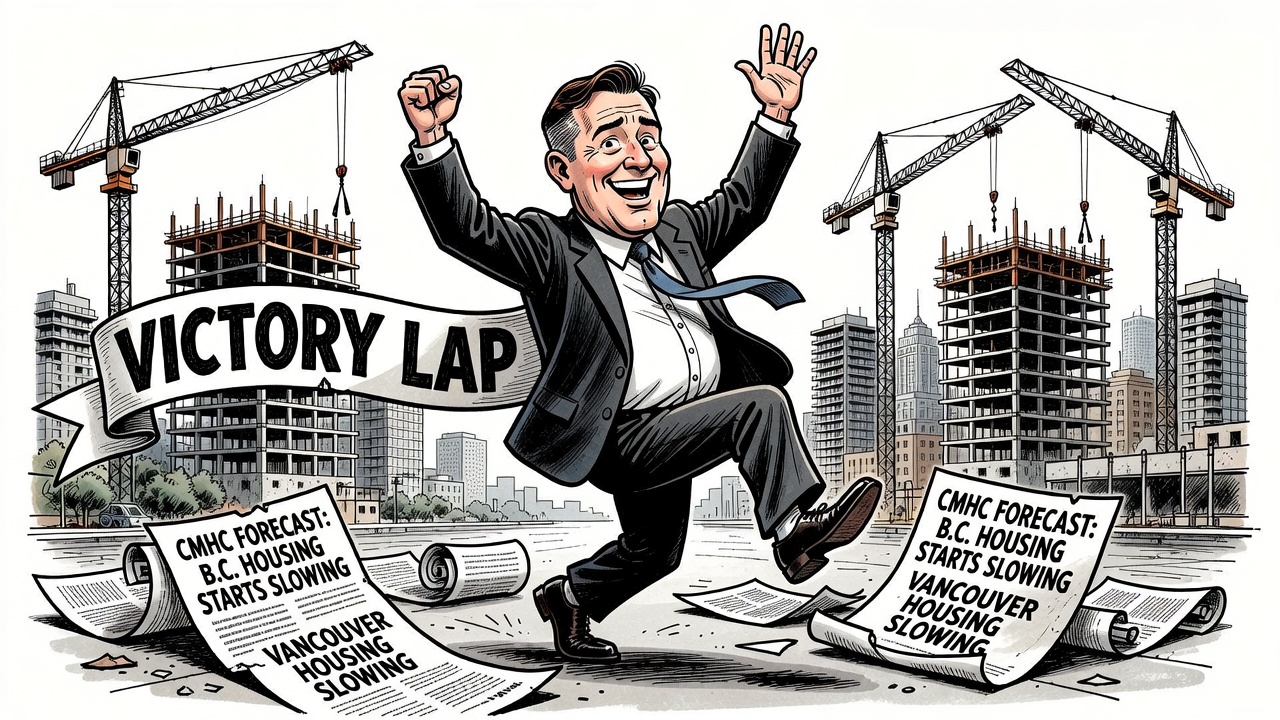
iVoteNDP editorial cartoon, June 7, 2026.
Announcements are not apartments. A groundbreaking is not a solved housing crisis.
Premier David Eby wants British Columbians to hear that his housing plan is “delivering.” The province’s June 2 release says BC Builds has broken ground on its 4,000th unit, and it points to nearly 820 new homes under construction across two Burnaby projects. Those are real projects, and the units should be counted.
But the details make the victory lap look a lot less urgent. The province says the 338-home Cassie Avenue project is anticipated to complete in 2028. The 480-home Southside Community Church, also known as The Neighbourhood Church, project is anticipated to complete in 2030. For a renter making decisions in 2026, “come back in 2028 or 2030” is not a housing solution. It is a construction schedule.
The sharper problem is that the same week the NDP was selling momentum, Canada Mortgage and Housing Corporation was warning that momentum is weakening. CMHC’s 2026 Housing Market Outlook says construction and home sales in Ontario and British Columbia will be weaker than their 10-year averages. It says Vancouver housing starts are expected to keep trending down as high construction costs and weakening demand weigh on new project activity, especially condominiums.
CMHC’s B.C. outlook goes further. It says new home construction in B.C. markets will trend lower in 2026 after strong apartment activity in 2025, and will continue to decrease later in the forecast period. It warns that builders are facing rising costs, weak demand, stalled condominium presales and rental projects that become harder to justify as vacancy rises and rent growth slows.
That does not mean every NDP policy has failed or that no homes are being built. It does mean the government’s political framing is selective. The public gets ribbon-cutting language, milestone numbers and carefully chosen rent comparisons. The harder federal forecast says the market underneath those announcements is fragile.
Housing affordability is not fixed because a government can list projects in a backgrounder. It is fixed when enough homes are completed, in the right places, at prices ordinary workers can actually pay. A 4,000-unit BC Builds milestone may sound impressive in a press release, but it is tiny beside the scale of B.C.’s shortage and slow beside the pressure families face every month.
Eby’s government has spent years centralizing housing power, overriding municipalities, promising speed and branding every announcement as proof of progress. If that plan is working as advertised, British Columbians deserve an answer to the obvious question: why is CMHC warning that B.C. construction is slowing and Vancouver starts are still trending down?
The NDP cannot govern by headline forever. The test is not whether Victoria can announce homes. The test is whether British Columbians can actually live in them before another election cycle passes.