Schoenborn Conditional Discharge Shows B.C.’s Public-Safety Trust Problem
This was a B.C. Review Board decision, not a cabinet order. But elected leaders still own the public-safety and mental-health system British Columbians are being asked to trust.
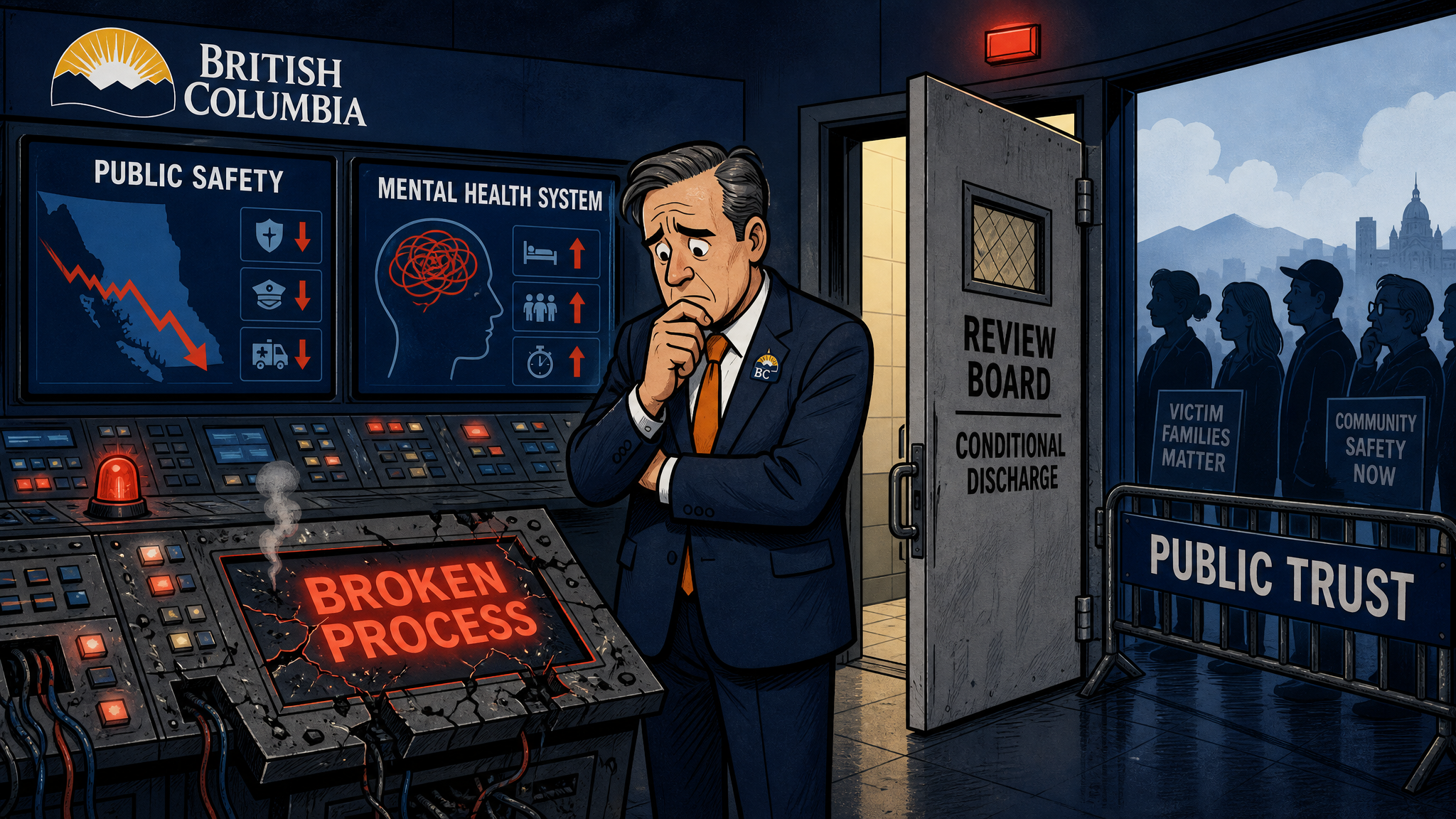
iVoteNDP editorial cartoon, June 4, 2026.
A justice system can be technically lawful and still lose public confidence when families are left feeling like an afterthought.
The B.C. Review Board has granted Allan Schoenborn a conditional discharge, and the public reaction should surprise nobody. Schoenborn was found not criminally responsible for the 2008 first-degree murders of his three children in Merritt. Canadian Press reported that the decision took effect Tuesday and permits him to live under supervision while reporting to a psychiatric clinic, with return to the Forensic Psychiatric Hospital in Coquitlam if ordered.
The legal distinction matters. This is not a cabinet release, a parole-board decision, or a direct order from Premier David Eby. A Review Board operates under the criminal mental-disorder framework and applies legal tests around risk, treatment and liberty. Any responsible criticism has to say that clearly.
But that does not end the accountability question. Governments fund, staff, legislate and defend the systems that make these decisions. When the public hears that a man found not criminally responsible for killing three children is moving from hospital custody to a conditional discharge, the test is not whether officials can recite process. The test is whether victims’ families, communities and ordinary citizens believe the safeguards are credible.
On June 4, the family’s representative, Dave Teixeira, called the conditional discharge “baffling” and said it exposed shortfalls in B.C.’s mental-health and justice systems. CityNews also reported Port Coquitlam Mayor Brad West saying he was “outraged” and worried the decision moved Schoenborn closer to greater freedom. Former B.C. Conservative leader John Rustad used the decision to criticize the system under the NDP government.
The conditions reported by CityNews, Global News and Canadian Press are serious on paper: no firearms or weapons, no alcohol, cannabis or prohibited drugs, testing for drugs and alcohol, no direct or indirect contact with named family members, disclosure of intimate relationships, and supervision through psychiatric-clinic reporting. Those restrictions should be reported accurately.
The problem is confidence. The Schoenborn decision lands in an environment where the public is being asked to trust that supervision, reporting and forensic psychiatric oversight will work. It tells people that even the most horrifying cases can move another step away from secure hospital custody while families and communities are left to rely on monitoring they cannot see.
The NDP cannot overrule an independent Review Board because a decision is unpopular. Nor should any government pretend legal process can be replaced by rage. But Eby’s government can answer the public’s real question: what has it done to ensure forensic psychiatric supervision is strong enough, transparent enough and victim-centred enough to deserve trust?
Until that answer is clear, the government’s public-safety message will keep collapsing at the same point: victims and communities are asked to accept assurances from a system they increasingly believe is broken.
Sources and records
- Canadian Press via Halifax CityNews, June 4, 2026: family representative reaction and decision details
- CityNews Vancouver, June 4, 2026: local and political reaction
- CityNews Vancouver, June 3, 2026: Review Board conditional-discharge report
- Global News, June 4, 2026: conditions attached to the discharge
- Merritt Herald, June 4, 2026: local coverage of the Merritt case