NDP Is Accused of Changing the Rules to Save Its Secrecy Bill
The government says Bill 9 protects access rights. Critics say it weakens FOI — and now the Opposition says the NDP is bending legislative convention to rescue its own amendments.
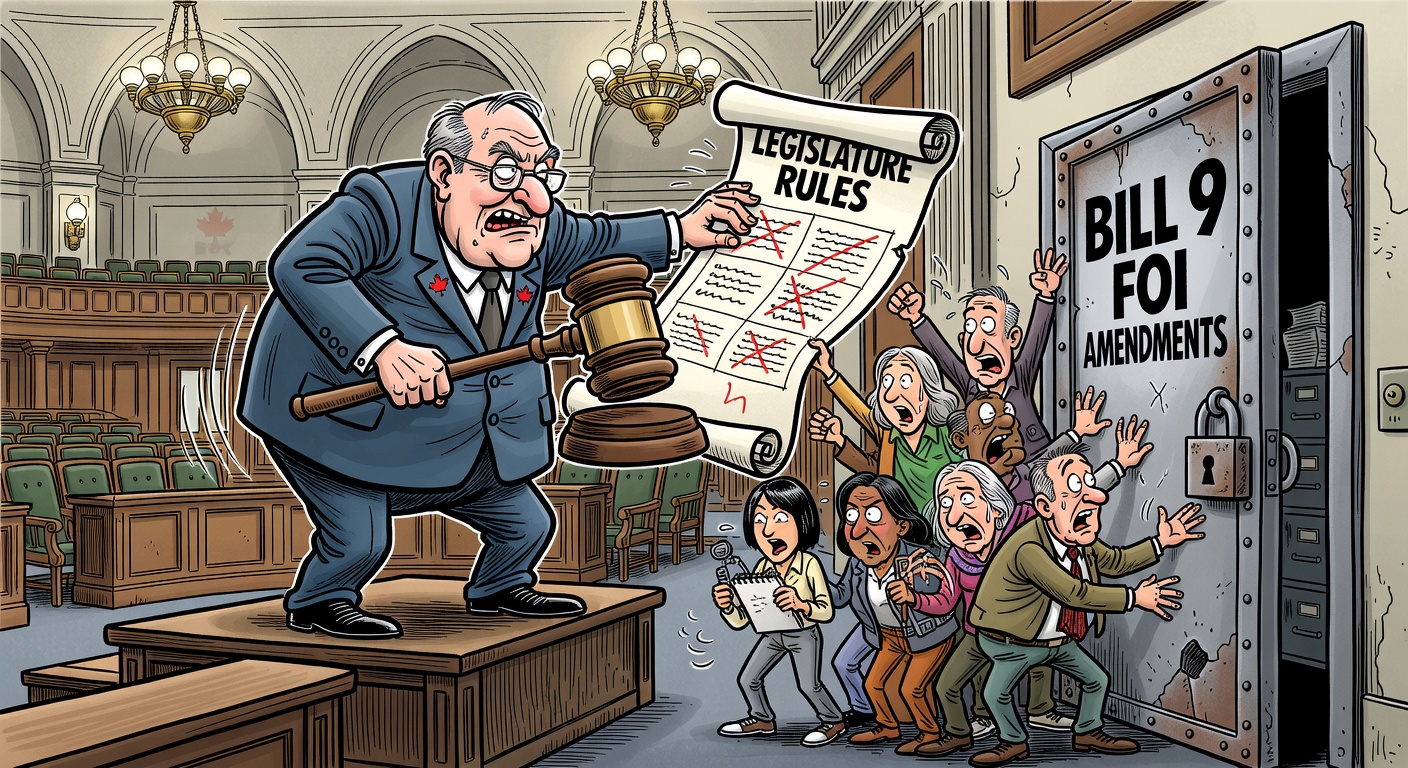
Editorial cartoon generated for iVoteNDP.com, May 21, 2026.
Update — June 3, 2026
Bill 9 has now advanced into third-reading text/status. This post’s secrecy/accountability critique should be read as post-amendment/status watch, not a claim that the bill is still awaiting final passage. Bill 9 status
Bill 9 was already a transparency problem. Now it is a process problem too.
On May 19, Conservative MLA Á’a:líya Warbus accused the NDP government of moving a procedural motion to adjust Legislative Assembly voting convention because it could not get its own Bill 9 amendments through committee without help from independent MLAs. That is an opposition allegation, and it should be treated as one. But it is a serious allegation because it lands on top of a bill that civil-liberties advocates had already warned would weaken access to government records.
Bill 9 is the Freedom of Information and Protection of Privacy Amendment Act, 2026. The government’s line is that the bill keeps B.C.’s access and privacy laws “strong, modern and effective.” Citizens’ Services Minister Diana Gibson said on May 4 that she was introducing targeted amendments to “bring further clarity” and reaffirm British Columbians’ right to access government information.
But the public should not have to choose between the government’s press release and the Opposition’s outrage. The text matters. The bill expands the grounds for disregarding requests, including where an applicant’s behaviour is considered “abusive or malicious,” where responding would “unreasonably interfere” with operations of a public body or the government of British Columbia, and where a request is “excessively broad.”
The watchdog warning came first
The BC Freedom of Information and Privacy Association warned in February that Bill 9 narrows access rights. FIPA pointed specifically to replacing the duty to respond “without delay” with “without unreasonable delay,” expanding disregard powers, and giving public bodies more say over whether request details and timelines are good enough.
That is not a minor paperwork dispute. FOI is how citizens, journalists and opposition MLAs find out what government did after the talking points are over. If the state can more easily delay, narrow or reject requests, accountability gets weaker no matter how often ministers say “modernization.”
The process now deserves daylight
Warbus’s claim is not that Bill 9 is merely bad policy. Her claim is that the government is trying to change procedural convention because it lacks the votes to move its own amendments through the normal committee process without independent support. The NDP may dispute that characterization. Fine — then show the public exactly what changed, why it was necessary, and who benefits.
What British Columbians should demand
- Publish the procedural motion in plain language.
- Explain why Bill 9 amendments cannot proceed under ordinary practice.
- Keep independent oversight over any expanded power to disregard FOI requests.
- Protect the duty to respond quickly, not just eventually.
The bottom line: a government that wants more discretion over public information should be extra careful with public process. Instead, Bill 9 keeps generating the same question: if the NDP’s transparency bill is so defensible, why does it keep needing shortcuts?