Too Big to Answer? Bonnie Henry, the NDP, and the Court Fight That Could Decide Whether B.C. Citizens Can Still Hold Government Accountable
After a 2.5-year wait and a 144-page refusal to certify one of Canada’s largest proposed class actions, CSASPP is appealing — and the case now reaches far beyond COVID into emergency powers, DRIPA uncertainty, land rights, and the future of civil liberties.
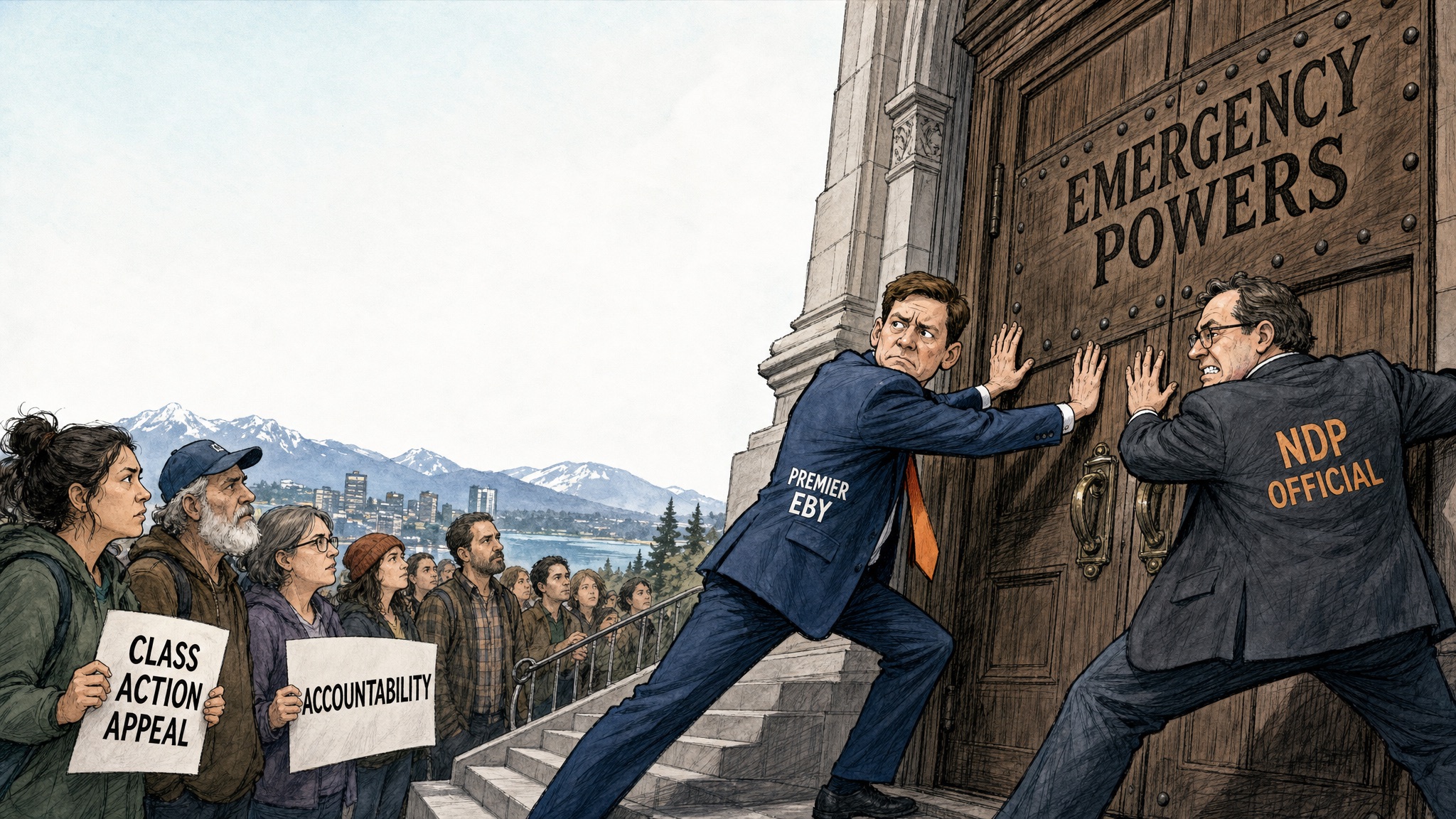
Editorial cartoon generated for iVoteNDP.com, May 19, 2026.
Careful reader note
This article is public-interest commentary, not legal advice. It does not claim the court found Dr. Bonnie Henry or the Province liable. The issue is whether citizens have a realistic, timely legal path to test extraordinary government power when it affects millions of people at once.
Careful note to readers: This article is public-interest commentary, not legal advice. It does not ask readers to decide whether Dr. Bonnie Henry, the Province, CSASPP, or any court acted unlawfully. The point is narrower, and more important: whether ordinary citizens should have a realistic legal path to test extraordinary government power when it affects millions of people at once.
1. The story in one sentence
A citizen-led, crowdfunded B.C. class action against the Province and Provincial Health Officer Dr. Bonnie Henry over COVID-era emergency measures was refused certification and struck after a long reserve period; CSASPP is now appealing, with its appeal factum expected by June 1, 2026 after an extension from the end of May — and the case has become far bigger than COVID.
It is now about whether collective accountability survives when government action is broad, complex, and politically charged.
2. Why this matters now
This should be a hot public issue because it sits at the intersection of several live concerns:
- Emergency powers — Can government impose sweeping restrictions and later avoid a broad accounting because the case is too large, too complex, or too procedurally imperfect?
- Public health authority — What legal remedies exist when public health orders affect livelihoods, worship, medical care, movement, assembly, family life, and dignity?
- Class action access to justice — If millions are affected by one policy framework, is a class action a realistic tool, or does scale itself become a reason to shut the door?
- Costs and intimidation — If a citizen group loses certification, can the state seek costs in a way that chills future public-interest litigation?
- DRIPA, land claims, and administrative power — The same procedural lessons may apply whenever government decisions reshape rights, property expectations, business certainty, or civil liberties across broad groups.
This is why the appeal matters. It is not just about one doctor, one pandemic, or one nonprofit.
It is about a rule-of-law question: When the state acts at scale, can citizens challenge it at scale?
3. Who is pursuing the case?
The group is the Canadian Society for the Advancement of Science in Public Policy, commonly known as CSASPP. It describes itself as a B.C. non-profit, non-partisan, secular, crowdfunded, volunteer-driven organization formed in response to public demand for legal action against B.C.’s COVID-related measures.
The key public-facing campaign is now framed around Sue Bonnie and the appeal effort.
Public avenues / social media / contact points
Based on CSASPP’s public pages and the provided screenshots:
- Website: covidconstitutionalchallengebc.ca
- Campaign / donation redirect: suebonnie.ca
- Donate page: covidconstitutionalchallengebc.ca/donate
- YouTube: @CSASPPOfficial / CSASPP
- Facebook: CSASPP
- Instagram: @csaspp
- Vimeo: CSASPP / csaspp
- Phone / fax: +1 (604) 256-3060
- Email: reception AT covidconstitutionalchallengebc DOT ca
The YouTube screenshots show CSASPP’s channel description, legal disclaimer, and links to the website, donation page, Facebook, Vimeo, and Instagram.
4. What the case was about
CSASPP’s proposed class action was brought against:
- His Majesty the King in right of the Province of British Columbia, and
- Dr. Bonnie Henry in her capacity as Provincial Health Officer for British Columbia.
The claim challenged COVID-era restrictions enacted through provincial emergency and public health legislation, including the Emergency Program Act, the Public Health Act, and the COVID-19 Related Measures Act.
The pleadings alleged breaches of sections of the Canadian Charter of Rights and Freedoms, including rights relating to fundamental freedoms, liberty and security of the person, arbitrary detention, and equality.
The proposed class was extremely broad: effectively adult British Columbians affected by COVID measures, with subclasses tied to different types of alleged harm.
That breadth is the heart of the controversy.
Supporters see it as the whole point: government measures touched millions, so accountability should be collective.
The court saw that breadth as a fatal procedural problem.
5. What happened procedurally
The court did not hold a full trial on whether Dr. Henry or the Province were right or wrong.
That is crucial.
The October 20, 2025 decision was about certification and strike applications — procedural gatekeeping questions. The court had to decide whether this specific claim, in this specific form, with these pleadings, these proposed common issues, these proposed representatives, and this litigation plan, should proceed as a class action.
Justice Crerar said the court was not deciding whether the pandemic measures were good, bad, lawful, wise, unwise, scientifically justified, or unjustified. The certification stage was about whether the action was properly structured to proceed as a class proceeding.
The claim did not pass that gate.
The court:
- struck the claim as an abuse of process;
- refused certification;
- denied the amendment application;
- left costs to be addressed later, though B.C.’s class action regime starts from a general no-costs presumption at certification unless exceptions apply.
6. Why did it take about 2.5 years for a decision?
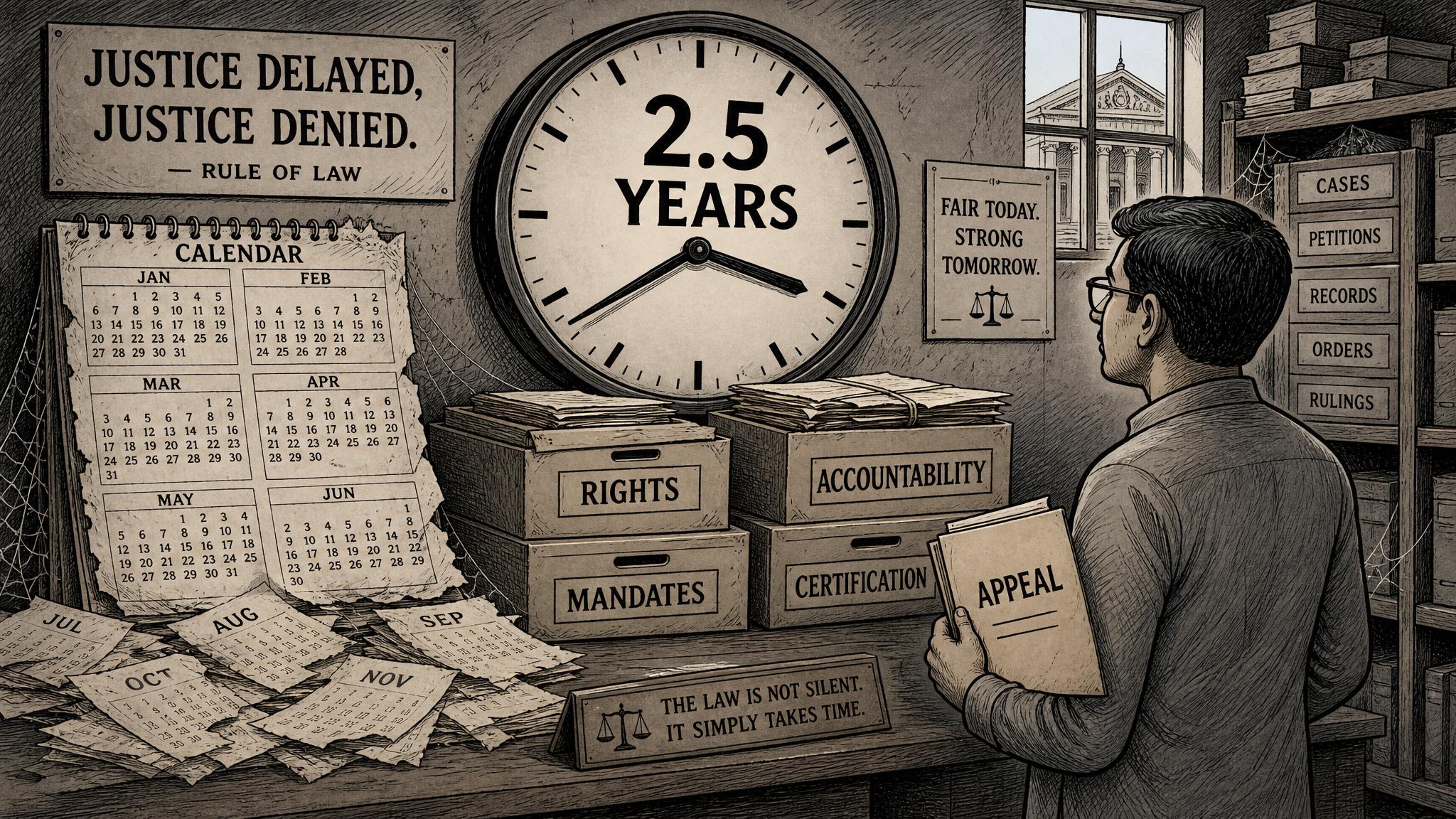
Editorial cartoon: when accountability waits years, public confidence pays the price.
This is one of the most publicly explosive parts of the story.
CSASPP and its supporters say the decision took roughly two and a half years after the certification hearings concluded. The hearing dates listed in the court decision were December 12–16, 2022 and April 24–28, 2023. The judgment was issued October 20, 2025.
That delay alone invites public concern. People hear “2.5 years” and understandably ask:
- Was the case too politically sensitive?
- Was the court trying to wait out public anger?
- Was delay itself a form of denial?
- If the defects were so obvious, why did it take so long?
Those are fair public questions — but we should be careful about what can be proven.
What can be said safely
The official record shows several reasons this decision was unusually hard to produce:
- The case was massive. The judge described it as one of the largest and most complex proposed class proceedings in Canadian legal history.
- The hearings were lengthy. There were 10 days of hearings.
- The record was enormous. The court referred to a wall of binders.
- The pleadings kept changing. The court emphasized that the claim was reformulated many times.
- Post-hearing submissions continued for years. The decision lists written submissions across 2023, 2024, and into 2025.
- The law was moving while the case was under reserve. Pandemic and Charter cases continued to be decided, and the parties filed additional submissions on legal developments.
- The decision was long. The reasons ran approximately 144 pages.
So, a careful explanation is this:
The delay appears to have resulted from the size and complexity of the proposed class action, the evolving pleadings and amendments, multiple rounds of post-hearing submissions, ongoing legal developments, and the court’s decision to issue very extensive reasons.
What CSASPP argues publicly
In the May 2026 Kid Carson interview, CSASPP’s executive director, Kip Warner, framed the delay more sharply. He suggested the decision could have been much shorter and issued much sooner, and argued that delay undermines public confidence in the justice system. He also suggested the timing may have blunted public momentum that existed when anger over mandates was higher.
That is an advocacy position, not a proven judicial finding.
But it is politically potent because it speaks to something many people already feel: the legal system often moves so slowly that the public issue is dead before the answer arrives.
For public communication, that is the strongest careful framing:
Whether intentional or not, a 2.5-year reserve period in a public-interest case about emergency powers has the practical effect of cooling public urgency, weakening fundraising, exhausting volunteers, and making justice feel unreachable to ordinary citizens.
That is fair. It does not accuse a judge of corruption. It focuses on the effect.
7. The main reason for the decision
There were many legal reasons, but the central theme was this:
The court found the proposed class action was too broad, too mutable, too individualized, and too procedurally unworkable to be certified as a class proceeding.
Put plainly:
The court did not say, “Everything the government did was right.”
The court said, in effect:
“This is not the right legal vehicle, in this form, to decide these claims for roughly four million people.”
The court’s major concerns included:
A. The claim was treated as an improper end-run around judicial review
Justice Crerar found that, at its core, the claim was really an attack on government orders and directives — the kind of challenge normally brought by judicial review, not by a damages-based class action.
The court was concerned that the action tried to reframe administrative-law challenges as Charter damages claims.
That matters because judicial review is usually deferential to specialized decision-makers. A damages action can open a much broader factual and remedial battlefield.
So the court’s concern was: you cannot use a class action to bypass the normal legal route for challenging administrative decisions.
That is a key appeal issue because citizens may ask: if judicial review is too narrow to give real accountability, and class actions are too broad, what remedy remains?
B. The pleadings changed too many times
The decision repeatedly criticized the claim as a moving target. The court said the pleadings had been reformulated many times and remained deficient.
That became part of the abuse-of-process finding.
This is a hard but important lesson for future public-interest litigation: the moral force of a claim is not enough. If the pleading structure is unstable, the court can shut the case down before evidence is ever tested.
C. The class was too broad and unclear
A class action needs an identifiable class. The court found the proposed class and subclasses were both overbroad and imprecise.
If the class is “everyone affected by COVID measures,” the immediate problem is that almost everyone was affected, but not in the same way.
One person lost business income. Another missed medical care. Another objected to vaccine status rules. Another objected to worship restrictions. Another had no practical damages. Another supported the orders. Another might prefer to bring an individual claim.
The court found that the class lacked the kind of legal commonality required for certification.
D. The common issues were not common enough
This may be the most important legal point.
Class actions depend on common issues. The common question must move the whole class forward.
The court found that alleged Charter breaches and damages would require intensely individualized inquiries. The health measures affected different people in different ways, at different times, under different orders, with different consequences.
That meant the case could fracture into many individualized mini-trials.
The court’s concern was not simply that the case was large. It was that it was large without a manageable common core.
E. Charter damages were treated as an unsuitable remedy in this structure
The claim sought damages for Charter breaches. The court found those claims legally vulnerable, especially against Dr. Henry because of statutory immunity under the Public Health Act unless bad faith is properly pleaded and established.
The court also found that Charter damages were not an appropriate or just remedy in the way the claim was framed.
F. The representative plaintiff problem
The court was not satisfied that CSASPP, as a society, or the proposed individual plaintiffs, were appropriate representatives for millions of class members.
This was another critical certification failure.
A class representative does not just speak for supporters. If certified, the litigation can bind absent class members who may not even know the case exists. Courts therefore require confidence that the representative can fairly and adequately represent the class.
The court did not have that confidence.
G. The litigation plan was not workable enough
For a case of this size, the court expected a detailed, credible plan for how the case would proceed, how people would be notified, how evidence would be gathered, how individual issues would be managed, and how damages could be assessed.
The court found the plan inadequate for the scale of the proposed proceeding.
8. What the decision does not decide
This is vital for public messaging.
The decision does not finally decide:
- that every COVID order was lawful;
- that every mandate was scientifically justified;
- that no one was harmed;
- that no Charter rights were limited;
- that citizens should never be able to sue over emergency measures;
- that public health officials are morally above scrutiny.
It decides that this particular proposed class action failed the certification and pleading tests.
That distinction is the opening for public interest.
The question for the appeal, and for the public, is whether the lower court applied those gatekeeping tests too strictly in a case where the whole point was collective harm from collective government action.
9. The appeal status
CSASPP has filed or commenced the appeal process. Its April 29, 2026 status update says the parties consented to extend CSASPP’s deadline to file its appeal factum to June 1, 2026, with Dr. Henry’s factum due August 31, 2026.
Earlier timelines referred to an end-of-April deadline, and the Kid Carson interview discussed the practical end-of-May push. The current public update says the filed deadline is now June 1, 2026, which is effectively the first business day immediately after the end of May.
That is the cleanest wording:
The appeal materials are expected at the end of May / by June 1, 2026.
CSASPP is fundraising for the appeal and says it requires significant public support to complete it.
10. The May 2026 Kid Carson interview — what mattered
Video reviewed
Kid Carson - 213 - The Case Against Bonnie Henry *UPDATE*, uploaded by CSASPP on May 11, 2026. The interview discusses the Sue Bonnie campaign, the certification decision, fundraising, costs, and the appeal timeline.
The recent Kid Carson interview is important because it translates a dense 144-page court decision into a public narrative.
The interview’s major themes were:
1. CSASPP says the case was never just one person’s grievance
Warner emphasized that the case was designed as a class action on behalf of millions affected by B.C.’s COVID measures, not a narrow personal dispute over one restaurant, one job, or one event.
2. The class action tool was framed as access to justice
Warner discussed the Class Proceedings Act as a tool originally designed to allow collective redress where many people are affected and individual lawsuits are impractical.
This is a powerful point for the public: if people are affected one by one, but the cost of individual litigation is impossible, then without a class mechanism many claims die without ever being tested.
3. The decision was characterized as “too big”
Warner’s core critique was that the case was rejected because it was too large, too complex, and under-resourced. He argued that this logic is dangerous because it can reward institutions for creating harms at a scale too large for ordinary people to challenge.
The public-facing line writes itself:
If a case can be dismissed because it is too big, then the bigger the government action, the harder it becomes to hold anyone accountable.
4. The delay was framed as damaging to public confidence
Warner argued that waiting roughly 2.5 years for a certification decision undermines public confidence, especially in a politically charged case.
The safe version: delay may not prove improper motive, but it absolutely affects access to justice.
5. The appeal was framed as urgent
The interview emphasized that the appeal factum requires serious legal work, public funding, and fast action.
6. Costs were framed as a chilling tactic
Warner discussed Dr. Henry / the Province seeking costs after certification failed, and argued there is a contradiction between saying CSASPP lacked resources to carry the case and then suggesting it has deep pockets for costs.
That line will resonate because people understand the asymmetry: government defends itself with taxpayer-funded resources, while citizen litigants rely on donations.
11. Why this case can catch fire publicly
The strongest public angle is not “COVID was fake” or “Bonnie Henry is evil.” That approach is too easy for critics to dismiss.
The stronger angle is:
No public official should be above a serious, timely, collective legal accounting when emergency powers restrict everyday freedoms.
That frame reaches far beyond the anti-mandate audience.
It can speak to:
- civil libertarians;
- small business owners;
- health care workers;
- religious communities;
- parents;
- Indigenous and non-Indigenous communities affected by sweeping policy changes;
- property owners concerned about land-title uncertainty;
- taxpayers concerned about emergency spending;
- lawyers worried about access to justice;
- people on the left and right who distrust concentrated executive power.
The case should be framed as democratic accountability, not just pandemic grievance.
12. The bridge to DRIPA and land claims
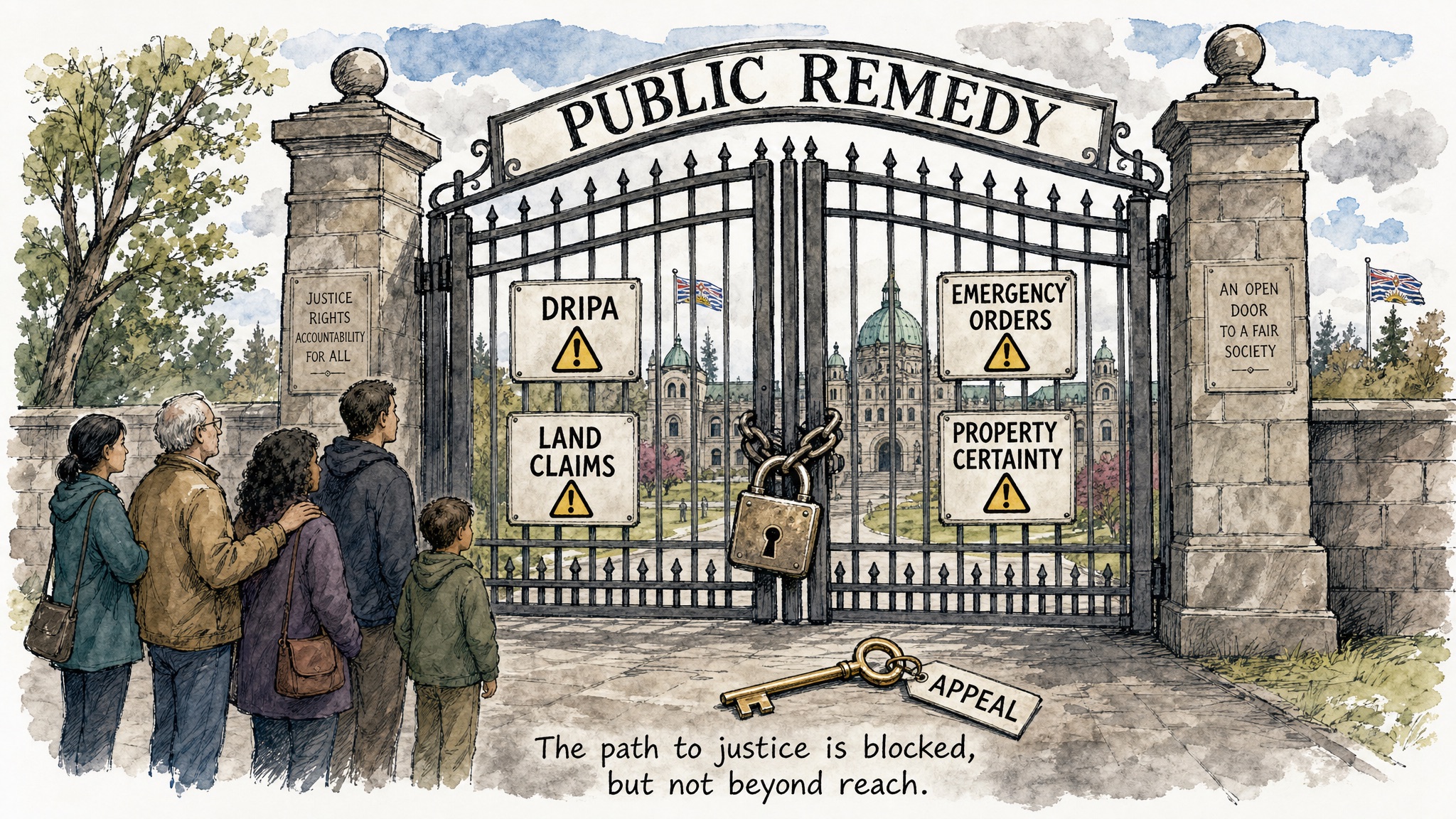
Editorial cartoon: the same question keeps returning — where is the public remedy?
This must be handled carefully.
DRIPA, Aboriginal title, and Indigenous rights are not the same as COVID health orders. Indigenous rights are constitutionally protected under section 35 of the Constitution Act, 1982, and the legal framework is distinct.
The point is not to use the Bonnie Henry case “against Indigenous people.” That would be wrong and counterproductive.
The point is to examine whether similar procedural tools can be used to test government process, legal certainty, consultation, jurisdiction, and rights impacts when government action affects broad classes of people.
Why the procedural lesson matters
The Bonnie Henry case teaches that the first battle is not always the moral or factual issue. The first battle is procedural:
- Is this a judicial review or an action?
- Is there a viable cause of action?
- Is the proposed class identifiable?
- Are the issues truly common?
- Is a class proceeding the preferable procedure?
- Is there a proper representative plaintiff?
- Is the litigation plan workable?
- Are there overlapping proceedings that create abuse-of-process risk?
- Is the remedy realistic?
Those questions matter just as much in land, resource, property, DRIPA, and rights-based litigation.
Possible DRIPA / land-claims applications
A carefully designed public-interest challenge could potentially focus on:
- Procedural fairness: Did government change legal or regulatory expectations without adequate notice to affected people?
- Statutory interpretation: Has DRIPA been interpreted or applied in a way that exceeds what the legislature clearly authorized?
- Administrative decision-making: Were mineral claims, land-use approvals, permits, or agreements handled reasonably and lawfully?
- Rights balancing: Were the interests of affected landowners, businesses, municipalities, or tenure holders properly considered?
- Legal certainty: Did government create uncertainty and then attempt to shift the cost of that uncertainty onto citizens?
- Transparency: Were key policies negotiated or implemented without sufficient public visibility?
- Equal access to courts: Are some groups being told they must absorb government policy consequences without a realistic remedy?
Why a class action may or may not work
A class action could be useful where many people are affected in the same legal way by the same government action. But the Bonnie Henry decision warns that courts may reject a class if:
- the harms vary too much person by person;
- the class is too broad;
- the proposed common issues are only thematically connected;
- the case is really a judicial review dressed up as damages;
- the representative plaintiff is not clearly suitable;
- the litigation plan is not strong enough.
For DRIPA or land claims, the better route may sometimes be:
- a targeted judicial review;
- a declaratory action;
- a test case by directly affected landowners or businesses;
- a municipal or industry-backed intervention;
- a coalition-supported appeal;
- a narrow class action only where commonality is very strong.
The lesson is not “copy the Bonnie Henry case.”
The lesson is build the next case so the court cannot say it collapsed under its own weight.
13. The current public attention hook: DRIPA, Cowichan, Gitxaala, and legal uncertainty
B.C. is already in a public fight over legal certainty.
Recent Indigenous rights and title decisions, including the Cowichan title decision and DRIPA-related litigation, have triggered intense debate over:
- private property certainty;
- mineral tenure and exploration rights;
- who has authority over land-use decisions;
- whether courts or elected legislatures are driving policy;
- how reconciliation is implemented;
- whether the public understood what DRIPA would legally mean.
Premier David Eby’s government has moved back and forth on whether to amend, pause, or otherwise address DRIPA-related legal uncertainty. First Nations leaders have forcefully opposed unilateral changes.
This issue is already hot.
The Bonnie Henry appeal can be connected to it through one shared question:
When government creates sweeping legal consequences, what is the public’s remedy if those consequences were not clearly debated, clearly authorized, or fairly balanced?
That is the bridge.
14. The broader Canadian context: emergency powers are no longer theoretical
COVID restrictions and the federal Emergencies Act litigation have changed how Canadians view emergency powers.
The Federal Court found the federal government’s invocation of the Emergencies Act unreasonable and unconstitutional in relation to the 2022 convoy protests, and the Federal Court of Appeal later upheld key aspects of that finding.
That matters because it shows courts can and do find emergency declarations unlawful — but often only after the emergency is over.
That creates the same accountability problem:
- Government acts now.
- Citizens suffer consequences now.
- Courts decide years later.
- By then, the policy is gone, the damage is done, and the public has moved on.
This is why the Bonnie Henry appeal matters beyond B.C.
The practical question is whether constitutional accountability can happen while it still matters.
15. How to make this a hot public topic — ethical strategy
The public campaign should be fierce but accurate.
Do not overclaim. Do not say the court found Bonnie Henry guilty. It did not. Do not say the appeal is guaranteed. It is not. Do not make personal attacks that let opponents dismiss the movement as angry or reckless.
The winning frame is:
This appeal is about whether citizens still have a collective remedy when government power affects everyone at once.
A. Best core slogans
- Too Big to Answer?
- If It Affected Millions, Millions Deserve Answers.
- Emergency Power Must Not Mean Legal Immunity.
- No Official Should Be Above a Timely Accounting.
- When Government Acts at Scale, Citizens Need Remedies at Scale.
- Four Million People. One Closed Door. Appeal It.
- Rights Delayed Are Rights Denied.
- The Case Is Not Over. It Is Going Up.
B. Best short social post
B.C.’s COVID class action was not dismissed after a trial. It was stopped at the gate.
>
The court did not decide whether the mandates were right or wrong. It decided the case was too broad, too complex, and not suitable as framed for class certification.
>
Now it is under appeal.
>
The question is bigger than COVID: when government power affects millions, do citizens still have a collective remedy?
>
This is about emergency powers, public accountability, DRIPA uncertainty, land rights, and the future of civil liberties in B.C.
>
Too big to answer is not good enough.
C. Best long social post
The Bonnie Henry class action should be one of the biggest public-interest stories in B.C.
>
Why? Because the court did not hold a full trial on whether the government’s COVID measures were justified. The case was stopped at certification — the gatekeeping stage for class actions.
>
The court said the proposed case was too broad, too individualized, too procedurally flawed, and not manageable as a class action. CSASPP says that is exactly the danger: if a government action affects millions, the legal system should not make that scale the reason ordinary people cannot seek collective accountability.
>
This is now under appeal, with key materials expected by the end of May / June 1.
>
The implications go far beyond COVID. B.C. is already facing public anxiety over DRIPA, Aboriginal title, land claims, mining rights, property certainty, and emergency-style executive decision-making. The same question keeps returning: when government decisions reshape the rights and expectations of large groups of people, what remedy do citizens actually have?
>
If the answer is “individual lawsuits you cannot afford” or “judicial review too narrow to address the harm,” then access to justice becomes theoretical.
>
That is why this appeal matters.
>
Not because anyone is above criticism. Not because every claim is guaranteed to win. But because in a free society, public power must be answerable — especially when it is used at scale.
D. Suggested hashtags
- #TooBigToAnswer
- #SueBonnie
- #BCPolitics
- #CivilLiberties
- #RuleOfLaw
- #EmergencyPowers
- #AccessToJustice
- #DRIPA
- #LandRights
- #CharterRights
- #BCPoli
E. Content ladder
- Explainer thread: “What actually happened in the Bonnie Henry class action?”
- Clip campaign: cut the Kid Carson interview into 30–60 second clips.
- Graphic: “The court did not decide the merits.”
- Graphic: “Why 2.5 years matters.”
- Graphic: “Five certification hurdles.”
- Graphic: “Too big to answer?”
- DRIPA crossover explainer: “What COVID mandates, DRIPA, land title, and emergency powers have in common: legal accountability.”
- Call to action: follow CSASPP, read the decision, read the appeal, donate if aligned, contact MLAs, ask media to cover.
F. Media pitch angle
Pitch: B.C. citizens’ group appeals dismissal of one of Canada’s largest proposed class actions against pandemic orders — and the appeal may shape future challenges to government power, emergency measures, DRIPA uncertainty, and mass public-interest litigation.
G. Questions journalists should ask
- Why did a certification decision take roughly 2.5 years after hearings concluded?
- If the court says the case was too broad, what legal path exists for broad government action affecting millions?
- Should public officials have statutory immunity from Charter damages in emergency contexts?
- Should the Province seek costs against a crowdfunded public-interest litigant?
- What does this decision mean for future class actions against government?
- Could the reasoning affect land, DRIPA, resource, or property-rights litigation?
- What will the Court of Appeal be asked to correct?
16. The strongest argument for public interest
The most convincing argument is not emotional. It is structural.
Government has unique advantages:
- It writes the laws.
- It controls public institutions.
- It funds its defence through taxpayers.
- It can act immediately and litigate slowly.
- It often benefits from deference.
- It can argue immunity.
- It can argue complexity.
- It can argue mootness after orders expire.
- It can argue individuals should bring separate claims.
- It can argue class claims are unmanageable.
Citizens face the reverse:
- They must fundraise.
- They must organize volunteers.
- They must find counsel.
- They must survive delay.
- They must overcome procedural barriers before evidence is tested.
- They risk costs.
- They risk being dismissed as political.
That asymmetry is the story.
The public does not need to agree on every COVID policy to understand that imbalance.
17. The careful conclusion
The Bonnie Henry class action is now an appeal about access to justice.
The lower court’s message was that the case, as framed, was procedurally unfit: too broad, too complex, too individualized, too unstable in its pleadings, and not supported by a sufficient representative and litigation plan.
CSASPP’s public message is that this reasoning risks turning scale into immunity. If government action affects millions, and millions cannot proceed collectively because the case is “too big,” the public is left asking what accountability mechanism remains.
That is why this case matters.
Not because every claim must succeed.
Not because courts should rubber-stamp class actions.
Not because public health officials should be personally attacked.
But because emergency powers, land policy, DRIPA, public health mandates, and mass administrative decisions all raise the same question:
Can Canadians still force a full legal accounting when government power changes ordinary life at scale?
The appeal is the next door.
The public should be watching.
18. Source notes for verification
- Court decision: Canadian Society for the Advancement of Science in Public Policy v. British Columbia, 2025 BCSC 2051, Supreme Court of British Columbia, released October 20, 2025.
- CSASPP status updates: April 29, 2026 update confirms costs hearing adjournment and appeal factum extension to June 1, 2026; Dr. Henry’s factum due August 31, 2026.
- CSASPP website: covidconstitutionalchallengebc.ca.
- Sue Bonnie / donation redirect: suebonnie.ca.
- Kid Carson interview: “Kid Carson - 213 - The Case Against Bonnie Henry UPDATE,” CSASPP, uploaded May 11, 2026; description identifies the topic as the Sue Bonnie campaign and appeal.
- B.C. DRIPA sources: B.C. government Declaration Act pages and annual reports; 2026 news coverage on proposed DRIPA changes / suspensions and subsequent reversals.
- Class Proceedings Act: B.C. Class Proceedings Act, RSBC 1996, c. 50, especially certification and costs provisions.
19. Final headline package
Main headline
Too Big to Answer? The Bonnie Henry Class Action Appeal That Could Decide Whether B.C. Citizens Can Still Hold Government Accountable
Subheadline
After a 2.5-year wait and a 144-page refusal to certify one of Canada’s largest proposed class actions, CSASPP is appealing — and the case now reaches far beyond COVID into emergency powers, DRIPA uncertainty, land rights, and the future of civil liberties.
One-line hook
If government power affects millions, the legal remedy cannot belong only to those rich enough to sue alone.