Okanagan Falls Shows the NDP’s Closed-Door DRIPA Problem
A community voted to incorporate. The NDP government now says naming, boundaries, Letters Patent and Indigenous consultation still have to be worked through. That is exactly why voters deserved the full roadmap before the vote.
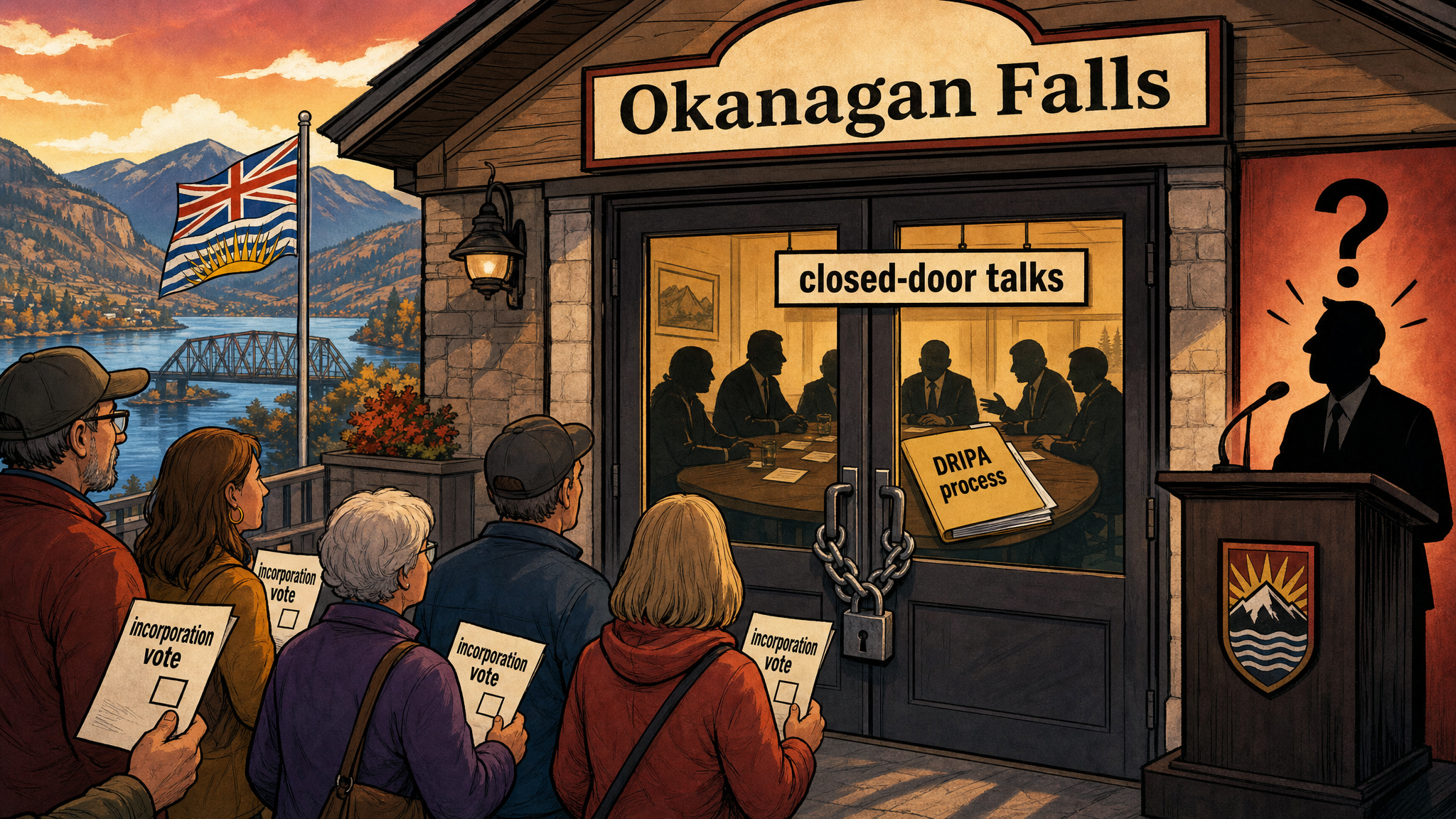
Editorial graphic generated for iVoteNDP.com, May 18, 2026.
Donegal Wilson’s Facebook clip on Okanagan Falls lands on a bigger B.C. problem: the NDP keeps asking the public to trust processes that are not clear enough for the public to judge.
Okanagan Falls residents voted on March 22, 2025 to incorporate as a new municipality. The Province later said this would be the first new B.C. municipality in 15 years, with Letters Patent expected before a mayor-and-council election in October 2026.
That should have been straightforward: a community chooses local self-government, the Province completes the legal documents, and residents elect the people who will represent them.
Instead, the process has become a DRIPA test case.
The government now says consent is part of the Letters Patent work
The Province’s own engagement page says the Ministry of Housing and Municipal Affairs is working with the Regional District of Okanagan-Similkameen and consulting with the Osoyoos Indian Band, “seeking consent” in the development of the Letters Patent.
The same page says the proposed incorporation area lies within Osoyoos Indian Band territory, includes unresolved land claims, and that the new municipality would have to observe legislation including the Local Government Act, the Community Charter, the Heritage Conservation Act and the Declaration on the Rights of Indigenous Peoples Act.
Consultation matters. Treaty and Aboriginal rights matter. The history of Okanagan Falls matters. None of that is the issue.
The issue is timing and transparency.
What is sourced
- Okanagan Falls voted in favour of incorporation on March 22, 2025.
- The Province said Letters Patent would address the boundary, council size, official municipal name and incorporation date.
- The Province appointed a facilitator and said it was consulting with Osoyoos Indian Band.
- The Province’s engagement page says it is “seeking consent” in developing the Letters Patent.
- The Province is considering a dual English and nqilxʷcən/nsyilxcən municipal name that retains “Okanagan Falls” as part of the name.
Wilson’s question is the right one
Wilson’s post says she asked a simple question in the Legislature: will the government commit to transparency as it enters new negotiations, or will British Columbians again be left in the dark until decisions are already made?
That is not an anti-Indigenous question. It is a democratic one.
If the Province knew before the referendum that naming, boundaries, unresolved claims, consent language and DRIPA implementation could materially affect the incorporation process, voters should have been told plainly before they voted. If the Province only discovered that afterward, then the public deserves to know why the process was launched without that clarity.
Either way, “trust us” is not enough.
The danger of government by closed-door process
Wilson’s earlier public statement went further, saying Okanagan Falls has been left without a dedicated elected municipal voice at the table while negotiations occur and while the community waits for incorporation. She argued that if the Province believes DRIPA requires negotiations before incorporation, the Province must admit the process presented to voters was flawed.
The NDP’s defenders will say this is complicated. They are right. That is exactly why the public record matters.
British Columbians should not learn after a vote that key conditions may still be under negotiation. They should not have to rely on rumours, partial updates or opposition clips to understand what the Province is doing. They should not be told that reconciliation requires a process they cannot see.
The bigger DRIPA warning
Okanagan Falls is not just a local incorporation story. It is a warning about how the NDP’s DRIPA implementation can reshape ordinary governance decisions: municipal boundaries, names, development approvals, land-use planning, infrastructure and local representation.
If the rules are clear, publish them. If consent is required, say what consent means. If consent is not a veto, explain what happens when agreement is not reached. If communities are voting on governance changes, tell them before the vote what conditions still need to be satisfied afterward.
That is how you build trust.
The bottom line: Okanagan Falls voters asked for local government. They should not be stuck watching closed-door talks decide the final shape of that government without a clear, public roadmap. Reconciliation cannot become an excuse for secrecy. The NDP owes Okanagan Falls answers.
Sources
Donegal Wilson MLA Facebook video shared by the user, video title “ARP2826_QP_WILSON_CHANDRA_HERBERT.MP4”; Donegal Wilson, “The Minister Refuses to Answer: Okanagan Falls Deserves Transparency”; Donegal Wilson, statement regarding Okanagan Falls incorporation; Province of B.C., Aug. 21, 2025 information bulletin; Province of B.C. govTogetherBC, Municipal Incorporation Process for Okanagan Falls.