Nurse Practitioners Say They Can’t Get Hired While 700,000+ Lack a Doctor
Global News reports B.C.-trained nurse practitioners are struggling to find work even as the province celebrates health-care recruitment and families wait for primary care.
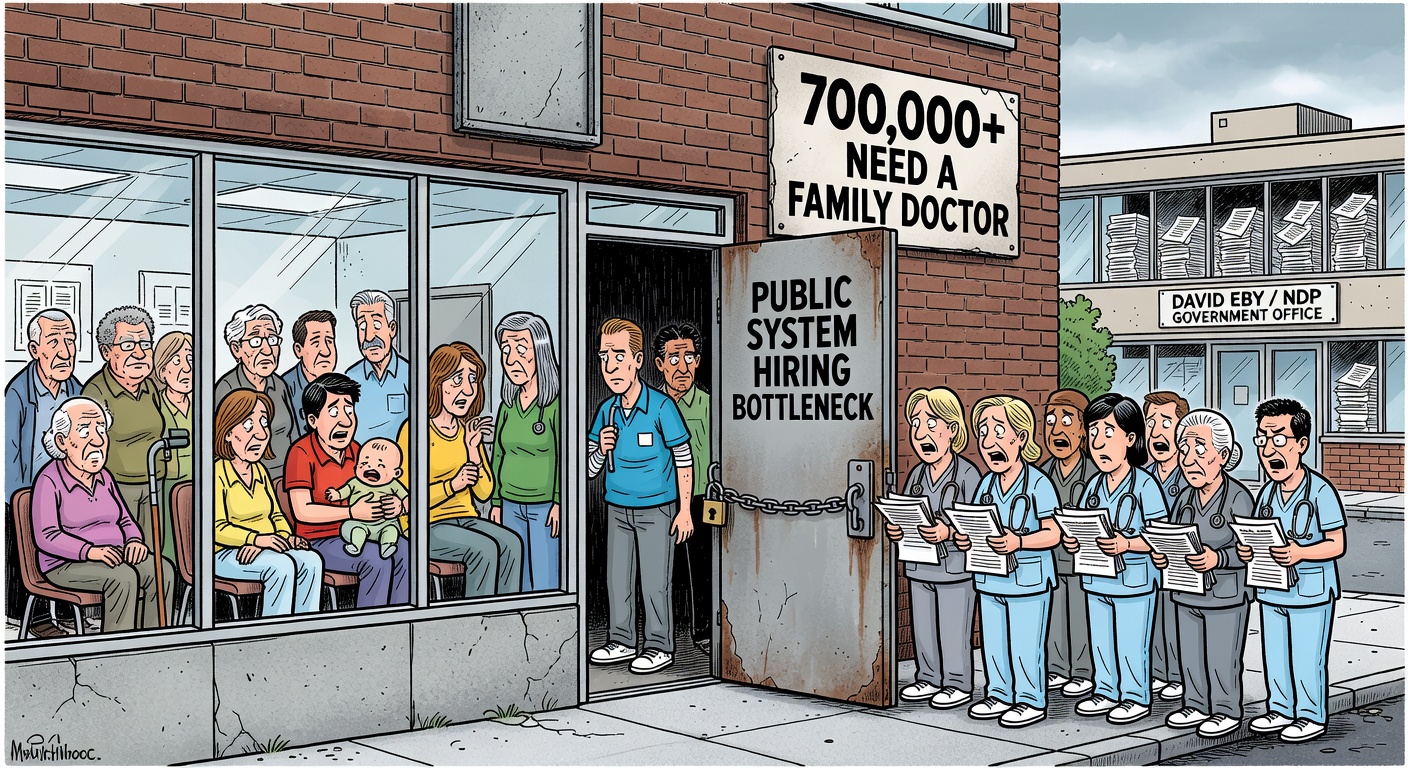
Editorial cartoon generated for iVoteNDP.com, May 10, 2026.
Source article
Global News, “Nurse practitioners struggling to find employment in B.C., despite high demand,” May 2026 — read the report. B.C. government health-worker recruitment release, March 17, 2026 — read the release.
British Columbia has a primary-care crisis. More than 700,000 British Columbians do not have a family doctor, according to Doctors of BC as cited by Global News. Nurse practitioners are supposed to be part of the solution. Instead, some say they are running into a hiring bottleneck.
Global News reported that students and new graduates are struggling to find nurse-practitioner work in B.C. Angela Wignall, CEO of the Nurses and Nurse Practitioners of British Columbia, said some students are being cautioned to keep their registered-nurse jobs after graduation in case they cannot find employment as nurse practitioners.
That should set off alarms inside the Ministry of Health. If B.C. is training nurse practitioners, telling the public it needs more primary care, and still leaving qualified local clinicians stalled outside the system, the problem is not demand. It is structure, funding and political management.
The contradiction
The province has been loudly promoting its recruitment of U.S.-trained health-care workers. In a March 17 release, government said more than 400 U.S.-trained health professionals had accepted job offers in B.C., including 89 doctors, 260 nurses, 42 nurse practitioners and 23 allied health professionals. The same release said more than 2,750 applications had come from U.S. doctors, nurse practitioners, nurses and allied health professionals.
Recruiting outside B.C. can be useful. But it does not answer why B.C.-trained nurse practitioners report stalled applications and limited openings while local patients wait. Wignall told Global that nurse practitioners are uniquely trained to provide primary care, yet the employment structures and funding decisions are not matching the government’s stated direction.
What is confirmed
- Global News reported more than 700,000 British Columbians lack a family doctor, citing Doctors of BC.
- NNPBC’s Angela Wignall said students and new graduates are struggling to find NP roles.
- The B.C. government said more than 400 U.S.-trained health professionals had accepted B.C. job offers as of January 2026.
- That government total included 42 nurse practitioners.
- Global reported B.C. has about 1,500 registered nurse practitioners, with projections of 3,700 by 2030.
Patients pay for system failure
Every unfilled primary-care slot has consequences. People without family doctors delay care, get sicker, and end up in emergency departments that are already under pressure. The NDP’s health-care announcements mean little if the system cannot absorb the trained professionals it says it needs.
The bottom line: B.C. should not have local nurse practitioners stuck in hiring limbo while hundreds of thousands of residents search for basic primary care. This is exactly the kind of operational failure voters are tired of hearing explained away.
Sources
Global News, May 2026; Province of B.C. health-worker recruitment release, March 17, 2026.